Posted in Album Reviews

Bob Dylan – Bringing It All Back Home (1965)

Bringing It All Back Home by Bob Dylan

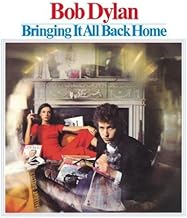
Bringing It All Back Home is the fifth Bob Dylan album and continues his departure away from focusing on mainly protest songs.  Another Side of Bob Dylan released in 1964 presented more personal lyrics, here Dylan explores surreal imagery along with a touch of psychedelia thrown in.  Controversially, the first side is devoted to electric songs played with a band while the second side is where longtime fans would find the mainly acoustic songs. 

Dylan gives a nod to the beat poets with a blast of bluesy rock and roll on the opener “Subterranean Homesick Blues”.  His first charting single in the US saw Dylan film a highly influential video for the track where he holds up cardboard cue cards with the lyrics written on them including the classic line, “Johnny’s in the basement, mixin’ up the medicine/I’m on the pavement, thinkin’ about the government”. “Maggie’s Farm” is a furious blast that was recorded in just one take as Dylan spits out the lyrics of working for little pay and no respect while you drive yourself insane.

The pace is slowed down on the love song “Love Minus Zero/No Limit” and the midtempo “She Belongs to Me” that speaks of a bohemian who is “an artist, she don’t look back/she can take the dark out of the nighttime and paint the daytime black”. Side one closes with the six plus minutes of “Bob Dylan’s 115th Dream” that breaks down into guffaws before the surreal track talks of the discovery of America. 

Side two opens with one of Dylan’s most beloved songs in “Mr. Tambourine Man” that was later taken to #1 in the US by The Byrds. Originally intended for the previous year’s Another Side of Bob Dylan, the song regularly features on best of lists and countless Dylan compilations. The acoustic side closes with two very different tracks – the first being the seven minute “It’s Alright, Ma (I’m Only Bleeding)”. The intense song is one that demands attention as Dylan tells us that “he not busy being born is busy dying” and that “I got nothing, Ma, to live up to”.  Side two closes with “It’s All Over Now, Baby Blue”, another track that is widely covered by other artists. Accompanied by the bass of Bill Lee, Dylan’s voice rises and falls with the music as he speaks about a love that is over or perhaps a goodbye to his younger self.

Dylan’s world was expanding during this time period as he met The Beatles for the first time, tried LSD, and in the summer of 1965 of would famously be booed at the Newport Folk Festival. Refusing to be just one type of songwriter that some want him to stay as, Dylan keeps growing and expanding his sound and lyrical inspiration. Bringing It All Back Home is another extraordinary album just three years and five albums into his then brief recording career.

10/10

Posted in Album Reviews

Bob Dylan – Another Side of Bob Dylan (1964)

Another Side Of Bob Dylan

A mere 8 months after releasing The Times They Are A-Changin‘, Bob Dylan returned with his fourth studio release, Another Side of Bob Dylan.  The album title is appropriate.  While Dylan continued to mostly feature just guitar and harmonica, all of which were played by himself, the songs take on a more personal nature versus the politically charged folk songs of previous efforts. All the tracks were recorded in just one day of recording with Producer Tom Wilson.

“All I Really Want to Do” is more of his new style as he sings and yodels, “…is baby be friends with you”. Dylan adds piano to “Black Crow Blues” that has a 50s rock and roll mixed with a bit of blues. Lighter tracks like “I Shall be Free No. 10” and “Motorpsyco Nitemare” add a dose of humour to the album. Even though it’s just played with an acoustic guitar, “Spanish Harlem Incident” could be a garage rocker where Dylan sings of a girl who’s “temperature is too hot for taming”. “I Don’t Believe You (She Acts Like We never Have Met)” describes the morning after the night before with a lover where the “morning’s clear/It’s like I ain’t here/She acts like we never met”. The refrain really brings “My Back Pages” home with its earworm lyric, “Ah, but I was so much older then/I’m younger than that now”.

Dylan returns to his political folk song roots on the seven minute “Chimes of Freedom” where he watches a rain storm that tolls “for the luckless, they abandoned and forsaked”. The only track here that appears on most compilations is the vulnerable, “It Ain’t Me Babe”.  Here Dylan tells a girl that he’s not the one for her and that she should find someone else.  It’s one of his classics that has endured to present day and was later covered by The Turtles and Johnny Cash.  Many other tracks here were covered by The Byrds and popularized through their folk rock movement including “Chimes of Freedom”. While Another Side of Bob Dylan may not be as beloved as some of his other massive albums from the 60s, it is one that newcomers to Dylan may be able to get into easier as it mixes some of the political with love, humour and a healthy dose of genius.

10/10

Posted in Album Reviews

Bob Dylan – Rough and Rowdy Ways (2020)

Rough And Rowdy Ways

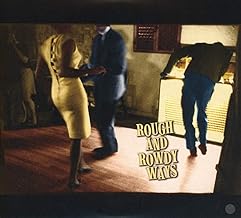
Back in late March, Bob Dylan released the nearly 17 minute single “Murder Most Foul”.  The track acts as an elegy for John F Kennedy as it focuses on his assassination.  “Right there in front of everyone’s eyes/Greatest magic trick ever under the sun/Perfectly executed, skillfully done”  The song then touches on pop culture that was occurring at that moment including The Beatles, the British Invasion, Thelonius Monk, etc. Similar in tone to Van Morrison with just piano and strings, the song has a dreamy quality of a man looking back upon his life. 

In several places on Rough and Rowdy, Dylan’s 39th studio album, he mentions his contemporaries and other historical figures including Anne Frank and The Rolling Stones on “I Contain Multitudes”.  The lead track is about living a life of contradictions with multiple layers. A phlegmy growl powers the bluesy “False Prophet” where the man sings, “I’m first among equals/Second to none/The last of the best/You can bury the rest”. Most of the 70 minute album has a slow to mid tempo speed.  “My Own Version of You” adds a bit of jazz noir to the proceedings in a track about putting body parts together to create something new.

Dylan’s voice is clear on “Crossing the Rubicon” and follows the a style that appears on a few other songs of having many verses with the name of the song featured in the last line of the verse. “Goodbye Jimmy Reed” mentions the blues legend on a rollicking track about religion. Lyrically the album is a dense lyrical wonderland but tracks like “Mother Of Muses” give the listener the chance to listen to the legend strum and sing a lovely little tune.  Similar in tone, “Key West (Philosopher Pirate)” mentions “Ginsberg, Corso and Kerouac” and that the “radio signal, clear as can be/‪I’m so deep in love that I can hardly see”. 

On a personal level, I’m familiar with most of Bob Dylan’s 60s albums plus a few others. This is the first Dylan album that I’ve purchased when it actually came out. Upon purchasing the The Complete Albums Collection Volume 1, I’ve gone back and started to review his albums in order, with a long way yet to go. As Dylan turns 80, he makes it all seem effortless on a collection that is a wonderful addition to his discography. Rough and Rowdy Ways is one that will endure beyond just being a late period footnote. 

9/10

Posted in Album Reviews

Bob Dylan – The Times They Are A-Changin’ (1964)

81MBKs-M7gL._AC_UY327_QL65_Like The Freewheelin’ Bob Dylan, this is another Bob Dylan album that sat on my shelf for years that I had not fully listened to until this year. Moving on from the colour of the Freewheelin’ album cover, The Times They Are A-Changin’ released in 1964 features just Dylan in a workman’s shirt bathed in green sepia. It’s back to business…

There are a number of gritty stories told, the first being “The Ballad of Hollis Brown” that paints a grim picture of a father killing his staving family. “The Lonesome Death of Hattie Carroll” is a sad recounting of an African American barmaid who was killed at the hands of William Zatzinger in a drunken rage. Billy went to jail but then lived until he was 69 years old. Carroll’s 9 children grew up without a mom. “With God On Our Side” goes through several conflicts with each warring nation thinking that they are in the right and that God is with them.

In the vein of the more things change, the more they stay the same. “North Country Blues” tells of struggling families in the American iron ore business losing their jobs as the work moves to cheaper South America. “Only a Pawn In Their Game” is a powerful track about the murder of Edgar Evers and how poor Caucasians are used as a pawn for white politicians to whip up anger at minorities.  Such was Dylan’s reach at that time that he sang this at the March on Washington before Martin Luther King Jr’s “I Have a Dream” speech. The title track is the one of the classic folk songs from the 60s and another Dylan track that seems like it was written a long time before that. “Come mothers and fathers throughout the land/And don’t criticize what you can’t understand”. A simple acoustic strummed song with important words and big ideas.

More so there than on the first two albums, it is a bit easier to see why the kids would later chasten Dylan for going electric. The power of Dylan with just his acoustic guitar singing dark stories happening in their own country while others their age danced around the clock. It is often a bleak outlook and by the end it’s a bit grim but it is as essential listening today as it was back then.

9/10

Posted in Album Reviews

Bob Dylan – The Freewheelin’ Bob Dylan (1963)

Our Bob Dylan journey continues as we work through The Complete Album Collection Vol. 1.  Here we arrive at his first classic disc, The Freewheelin’ Bob Dylan.  Released in May of 1963, a year after the self titled debut, it sees Dylan make a startling leap forward as he moves from mostly covers to mostly originals including several of his most important songs.  I did own this album before buying the box set but had never given it more than a few scattered listens throughout the years.

The first three songs alone seal the greatness of this album.  “Blowin’ in the Wind” takes the tune of “No More Auction Blocks” and creates one of the greatest folk songs ever written.  One that seems like it has been around forever, not just since The Beatles were singing “Love Me Do”. “Girl From the North Country” is influenced by old folk tune “Scarborough Fair” and is a lovely track of looking back on an old love, perhaps a high school sweatheart from back in Minnesota.  “Masters of War” is laser focused on the politicians in charge of pulling the war strings.  The anger at those who send kids off to war comes through in several scathing lines –  “come you masters of war… you that hide behind desks…I just want you to know, I can see through your masks”

Recognized by music scholars as one of his most complex, “A Hard Rain’s A-Gonna Fall” is episodic in nature.  Upon hearing it performed at the Gaslight Café, singer Peter Blankfield commented that “every line kept building and bursting”.  It’s hard not to stop what you’re doing while this plays and just listen. Still powerful 50+ years later. “Don’t Think Twice, It’s All Right” speaks of the loves that pass through one’s life for a short but intense time then disappear. “I gave her my heart but she wanted my soul” ….but that’s alright, it was good, now it’s time to move on. 

The first half of the album hits harder but the second half does have a few understated gems. “Oxford Town” is a short two minute track about James Meredith being the first black student to enroll at the University of Mississippi in 1962.  “Corinna, Corinna” is refreshing after the much longer “Talking World War III Blues”.  A traditional song with a few Robert Johnson lyrics thrown in. All the other songs leading up to this just feature Dylan so it takes a few seconds to realize there are drums and a band playing behind his impressive harmonica work. Based on a Leadbelly song, “I Shall Be Free” adds a bit of levity at the end of an album that addresses many serious topics that were at the forefront of 60’s culture.

The cover photo of Dylan walking down a street in the West Village with then girlfriend Suze Rotolo is iconic and one of the best album covers of all time.  Still ranking high in most lists of the greatest albums of all time, The Freewheelin’ Bob Dylan has not diminished at all. While not perfect, Dylan’s first classic album containing several towering songs is one that should be in all serious music collections.

10/10