Posted in Album Reviews

David Bowie – Low (1977)

The recording of Low was yet another transition in the extraordinary life of David Bowie.  Moving to Paris with Iggy Pop to escape drug addiction, the pair began work Pop’s solo album, The Idiot.  Once that wrapped up, Bowie started work on Low with Tony Visconti and ambient wizard, Brian Eno.  First recording in Paris before moving to Germany, this was the start on what has become known as the Berlin trilogy.

Split between two sides, the first side features mostly quick snappy rock songs with an avant garde bent.  “Speed of Life” is the instrumental opener, a solid 70s rock song with guitars and synths working away in the background. Both “Breaking Glass” and “What In The World” has some great guitar work from Carlos Alomar. “Sound and Vision” was one of only two singles from the album, reaching top 3 in the UK.  With an appearance from Mary Hopkins, the song has a bit of funk, recalling several tracks on the “Young Americans” album. “Always Crashing In The Same Car” sounds like the negative answer to Kraftwerk’s “Autobahn”, one where Bowie never gets out of the driveway, going around in circles while constantly making the same mistakes.

In contrast to the song fragments on side one, the second side sees lengthier soundscapes. “Warszawa” is a moody, oppressive piece named after the Polish city. Bowie plays all the instruments on “Weeping Wall” who’s synths and xylophone stay somewhat hopeful, never quote going down the dark/horror path they could before “Subterraneans” closes out the album. Conceived during the time of The Man Who Fell to Earth movie, synths are used like orchestral strings to draw out the cinematic feel of the track.

Listening to Low almost 50 year later, the the genre expanding sounds by a major selling artist makes it a seminal piece.  Its influence can be felt throughout the next several decades of music, notably on bands like Joy Division right through to Radiohead’s Kid A and many of the cold wave artists that have expanded on it’s icy synth sounds. Changing styles once again, on the album Low, Bowie moved his musical ambitions from the soul of America to the cold concrete of Europe.

10/10
Posted in Album Reviews

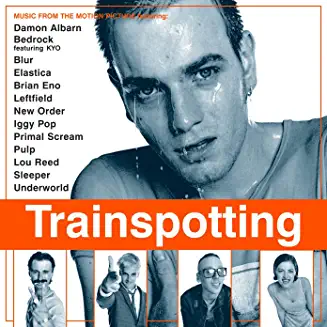
Trainspotting: Music from the Motion Picture (1996)

Trainspotting based on the Irvine Welsh novel follows the lives of several Scottish mates, most of whom are addicted to heroin. The movie depicts the staggering destruction the drug can do in a person’s life but also mixes in plenty of laughs and one of the best film soundtracks ever.  Mixing alternative classics, Britpop and techno – the soundtrack was massively successful upon release in 1996.  The album starts with the first of two big indie disco night hits with Iggy Pop’s “Lust for Life”. Originally released in the late 70s, the song gets a new release on life as a whole new generation discovers the classic drum beat from Hunt Sales.

The album immediately takes it’s foot off the gas for the ambient sounds of Brian Eno and the bubbling dance sounds of Primal Scream. Sleeper performs a very good faithful cover of Blondie’s “Atomic” before the New Order’s “Temptation” sings of “Oh, you’ve got green/blue/grey eyes”.  The album then takes one of the highlights from Blur’s underrated first album with “Sing”.  Lou Reed soundtracks one of the most powerful scenes in the movie when “Perfect Day” plays while Renton (Ewan McGregor) ODs before being revived in the hospital. The song’s deadpan singing of a wonderful day out perfectly fits the harrowing scene.

Originally a b-side, Pulp makes an appearance with “Mile End”, a fitting track that describes an unlivable flat in London that captures the domestic lives of the characters. Nearly bookending the album, Underworld’s smash techno crossover hit “Born Slippy .NUXX” appears. Playing in the final scenes of the movie, the song with it’s “lager lager lager” lyrics is regarded as a landmark electronic track. 

Arriving a few years before Napster and online streaming, the Trainspotting soundtrack plays like an excellent mixtape that people used to pass on to one another. While the segue from Iggy Pop to Brian Eno is an odd one, several of the tracks flow nicely from one track to the next.  Like any good mixtape, it has well known favourites and a few unknown gems for listeners to discover.  Like the movie, the Trainspotting soundtrack still holds up 25 years later.

9/10