Posted in Album Reviews

Davie Bowie – Station to Station (1976)

David Bowie started writing the songs that would end up on Station to Station in 1975 while working on the movie The Man Who Fell to Earth.  Deep in a cocaine addiction, Bowie in this time period was surviving on a diet of just peppers and milk. Co-produced by Harry Maslin, the sound of the album carries on some of the funk/soul influences he explored on Young Americans and adds a bit of a croon with a European shininess on an album that went top five in both the UK and US.

The title track is a 10 minute epic that begins with the sound of a train then a slow, trudging march of sounds.  The song introduces his newest character, the Thin White Duke.  The song gets sped up in the second half where it turns into a tour de force of drums and piano while Bowie sings, “It’s too late to be grateful”.  “TVC 15” is based on a hallucination of the TV eating someone’s girlfriend, the fun upbeat track adds a bit of a sci-fi element to the themes.  The twin guitars of Earl Slick and Carlos Alomar turn “Stay” into a dirty, funky jam that also features the throbbing bass of George Murray.

The first single is the highlight.  “Golden Years” carries on the funk rock sound he previously explored on “Fame”. The guitar riffing that starts the track gets punctuated with finger snaps and handclaps that beam the groove to life before Bowie’s vocal brings a bit of a bit of blue eyed soul to the disco gloss. Its an extraordinary song that the band + Bowie really nail.  Station to Station sees Bowie make the sounds explored on Young Americans truly his own.  How he created the album while in a deep drug addiction, barely remembering anything about this period is a minor creative miracle.

9/10

Posted in Album Reviews

David Bowie – The Gouster (2016)

When David Bowie released the second boxset in a career spanning history, Who Can I Be Now (1974-1976) in 2016, the set also included The Gouster. This album was never released but eventually came in out in a revised form as the Young Americans LP. The two albums share four tracks in common, all in alternate forms including the sax driven “Somebody Up There Likes Me”.  It also contains the track of the same name as the boxset, a midtempo piano driven track with a lot of horns as well.

The Gouster contains two future singles. The first being “Young Americans” that brims with Philadelphia soul and the second being “John, I’m Only Dancing”. The disco soul number would eventually be released in 1979 in edited form. The version here clocks in at 7 minutes, a true disco dancefloor edit.  Leaving off a few upbeat numbers from Young Americans, The Gouster is a slower take on what eventually would become a big album hit for Bowie in 1975.

7/10

Posted in Album Reviews

David Bowie – Young Americans (1975)

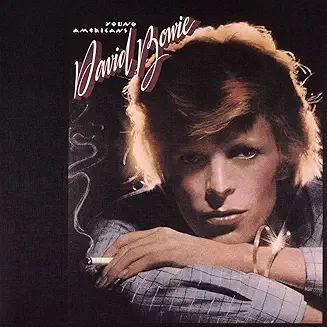
For several years in the early 70s, David Bowie was putting out British glam rock.  He took a sudden artistic turn in 1975 with the release of the soul/funk of Young Americans.  Working with guitarist Carlos Alomar for the first time + saxophonist David Sanborn, backup singers Luther Vandross and Ava Cherry – Bowie teamed up with producer Tony Visconti and Harry Maslin to record in the US for the first time. 

With the aforementioned talent behind him, the musicianship on the album is top notch.  The title track immediately has a loose vibe and a killer chorus by the R+B back up singers.  The new Philadelphia sound brims with energy on the plastic soul hit. “Win” is a late-night soul atmospheric jam before the gritty funk of “Fascination” that was based on a Vandross track.  Two of the final tracks include UK mate John Lennon. The first on an impassioned though not entirely successful cover of The Beatles’ “Across the Universe”. The second is the blockbuster, “Fame”.

“Fame” was Bowie’s first number one single in the US. The funk groove lays a bed on which Bowie singles on the ills of being famous.  It’s a classic track that helped usher in an era of rock stars incorporating US funk sounds (The Rolling Stones, Elton John, Rod Stewart, etc).  Young Americans is an interesting diversion on Bowie’s albums.  Not all of it works but his genuine interest to record this music results in a couple of classic Bowie tracks and a few other good ones. 

7.5/10

Posted in Album Reviews

David Bowie – David Live (1974)

While other David Bowie’s live albums may have been recorded earlier, David Live was the first one released.  The disc was recorded during 1974’s Diamond Dogs tour at a stop in Pennsylvania. Having left behind the Ziggy Stardust personae the year before, Bowie adds horns to the mix including the work of David Sanborn (RIP) and piano player Mike Garson that play a heavy role in the songs performed for the album.  This adds a bit of a jazzy flavour to tracks like “Changes” and “Aladdin Sane”.

The band really let loose on “Moonage Dream” including a sizzling guitar solo from Earl Slick and Tony Norman going for it on the drums.  The background vocals on the Eddie Floyd cover “Knock on Wood” truly make it sound like an arena rock show from the 70s.  At times, Bowie’s voice strains a bit to get into range but the enthusiasm of tracks like Diamond Dogs’ single “Rebel Rebel” and “Cracked Actor” plus the impassioned performance of “Rock n Roll Suicide” make it easier to overlook. 

Several singles up to that point are left off the performance such as “Space Oddity”, “Starman” and “Live on Mars”. In truth, he had so many songs to choose from even at this point that they are not hugely missed. In all, David Live captures Bowie between Ziggy and the Young Americans phase that was just a year away.

7/10

Posted in Album Reviews

David Bowie – Diamond Dogs (1974)

David Bowie returned in 1974 with Diamond Dogs that was to be based on George Orwell’s sci-fi novel 1984, among other partially worked out ideas. The project sees him once again working with Tony Visconti, on a vision that creates a sleazy, post-apocalyptic future. After a spoken word introduction, the title track announces “This ain’t rock n roll, this is genocide”.  The backing vocals sounds like they are coming from underwater on the gritty fan favourite.

Through a three song suite, “Sweet Thing (Reprise)” appears as a punk/funk blast that rides into the classic single, “Rebel Rebel”.  Surprisingly, this was a top five hit in the UK but missed the top 50 in the US. Still a sure-fire dancefloor filler and a great singalong to the chorus ender, “Hot Tramp, I love you so” over a killer guitar riff from Bowie who took over the role from Mick Ronson. “Rock n Roll With Me” has a catchy chorus and more of a classic 70s rock sound.  Later, “1984” gives a glimpse into Bowie’s future sound with Blaxploitation funk on a track that was then covered by Tina Turner.

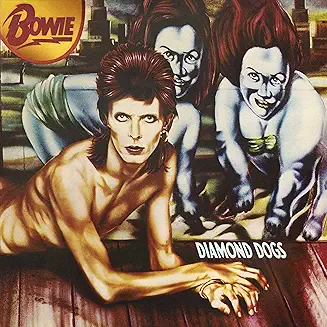
Throughout its history, Diamond Dogs has very mixed reviews.  From classic status in one publication to less than complimentary write-ups by other reviews.  It is a mixed bag of tracks that are actually quite good but right from the unappealing cover art of Guy Peellaert to the creepy spoken word introduction, it leaves a bit of a bad taste.  Still, even Bowie with a few partial ideas for an album can influence sounds later heard on punk, goth, and the dirtier/artier side of Britpop.

7/10