Posted in Album Reviews

The Doors – Morrison Hotel (1970)

Upon release in 1970, Morrison Hotel from The Doors was hailed as a return to form after two middling albums.  The album is split with the Hard Rock Café first side and Morrison Hotel second side. “Roadhouse Blues” kicks off the album with a stellar guitar riff from Robby Krieger.  Barroom blues played to excellence, over a rolling piano Jim Morrison belts out “I woke up this morning and I got myself a beer” before imploring the audience to “let it roll, baby, roll”.

“Waiting For The Sun” is a more atmospheric track that is zen like in the beginning but as it goes on, the Morrison mantra of the word “waiting” becomes harsher, more demanding. Closing out the first side, “Ship Of Fools” sounds lighthearted before Morrison sings the first line, “the human race was dyin’ out”. Side two gets is off to the races with “Land Ho!”, driven along by the drumming of John Densmore and organ of Ray Manzarek. “Queen Of The Highway” is notable for sounding like a track that could have been released in the 90s by a hip indie rock band with an organ.

One of the finest tracks on the album was never released as a single and seldom appears on compilation albums.  Co-written between Morrison and Krieger, “Peace Frog” is instantly recognizable with it’s wah wah guitar.  The funk boogie swing sounds like the ultimate party song until you tune into the lyrics with Morrison singing of blood in the streets of Chicago and New Haven.  The track then segues into the crooning love song of “Blue Sunday”.  Often played together, this passage is a highlight of their catalogue. The critics and fans 50+ years ago were correct, Morrison Hotel is an excellent return to form for The Doors.

9/10

Posted in Album Reviews

The Doors – The Soft Parade (1969)

The Doors last album of the 60s, The Soft Parade, is a mixed bag of sorts.  Combining their Californian take on the blues (“Shaman’s Blues”) and lengthy album closer (“The Soft Parade”), the band add orchestration and a nostalgic feel to their sound.  The story goes that singer Jim Morrison hated the Robby Krieger penned opening track, “Tell All The People”.  Still, Morrison turns in a solid vocal performance on the somewhat schmaltzy track. Not coincidently, this is the first album by The Doors where songs are credited to individual writers instead of the band as a whole.

Much better is the top 3 US hit, “Touch Me”.  The organ and drumming of John Densmore build up before the song bursts into a showtune.  A sax solo later appears as Morrison croons, “I’m going to love you/Til the heavens stop the rain”.  One of The Doors finest songs.  While mostly inessential, “Do It” sounds like it could have been released in the late 80s during the second coming of love with it’s swirling organ and groovy bass. The band give a nod to Otis Redding who had recently passed away on “Runnin’ Blue” and throw a few good guitar licks on “Wild Child”.

The aforementioned title track reaches for greatness like previous album closers, but instead goes all over the place then ends up nowhere.  The album went top ten in the US but did inexplicitly neither “Touch Me” nor the album charted in the UK. One of the lower reaches of The Doors career but still turns in a few fine performances especially the drumming of Densmore.

7/10

Posted in Album Reviews

The Doors – Waiting For The Sun (1968)

Waiting for the Sun (40th Anniversary Mixes) [Expanded]

The third album by The Doors, Waiting For The Sun, was released in July 1968.  After using up many of their original song ideas for the first two albums, the band was forced to write new ones.  One holdover from older Jim Morrison ideas was second single, “Hello, I Love You”.  The track that bears a resemblance to The Kinks’ hit, “All Day and All of the Night” went to #1 in the US and is a staple on classic rock radio.  The driving pop of that second single was in stark contrast to “The Unknown Solider”. The first single released from the album was an anti-war song describing a solider being shot in the head while those at home merely read about the news over breakfast.

Several fine album tracks appear on side one including “Love Street” that rolls along like a hazy summer day, Ray Manzarek’s piano keeps the song moving.  “Wintertime Love” feels like an updated take a song from the 1800s as Morrison sings, “winter’s so cold this year, you are so warm, my wintertime love to be”.  Darker is “Not To Touch The Earth” which was originally a piece of a 17 minute recording for the album. The song takes in the more sinister side of California where the “dead president’s corpse in the driver’s car/the engine runs on glue and tar”.  John Densmore’s hard drumming and the swirling keyboard make the surreal track disorientating.

Side two starts with the flamenco style guitar of “Spanish Caravan” and ends with the proto metal track “Five to One” that has a buried Robbie Krieger guitar solo.  The songs in between are all fine but are less memorable than their side one brothers. While Waiting For the Sun ranks critically as one of the lesser albums from The Doors, it was their only #1 US album, staying there for four weeks.  Casual fans can likely take a miss here but there are still several solid moments to keep the deeper listener satisfied.

7.5/10

Posted in Album Reviews

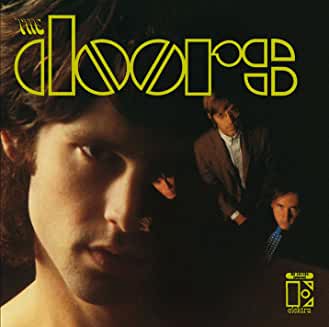
The Doors – The Doors (1967)

81dWUePuUsL._AC_UY327_QL65_I still remember the first time I ever heard The Doors. It was around 1983 when I was about 8-9 years old. I was sitting in the car waiting for my mom and listening to the radio when they played “Light My Fire”. Even at that age I was blown away. Arguably their most popular song and one of the best singles of the 1960s, the Robby Krieger composition is memorable for the first drum kick before the organ line leads into the shamanistic lyrics of Jim Morrison. After the song ended, the DJ then said some nonsense about how some people thought Jim Morrison was still alive. I thought that it sounded ridiculous at the time but I still remember it to this day.

Many years later, I picked up The Doors disc about 20 years ago for £2.99 at HMV on Oxford St in London. It seemed like the perfect album to have for the one room flat I shared with my Australian roommate. It went on to soundtrack many walks through London parks, returning late from the pub and one particularly debauched night at home.

The first single released from the 1967’s s/t album was first track “Break on Through” that flopped on original release but later became classic rock FM staple. Like on “Light My Fire”, the first sound here is also John Densmore drum which has a bossa nova swing along with Krieger’s dirty guitar line. The atmospheric “The Crystal Ship” sees Morrison ask for “another kiss before slipping into unconsciousness”. One of the most famous tracks on the album is a cover of “Alabama Song”, a Bertolt Brecht poem originally set to music by Kurt Weill in the 20s. It’s a surreal leftfield choice with Ray Manzarek’s swirling organ/keyboards that sound like a hazy day at the circus or one that would appear in a dream.

Side two on the album opens with the obligatory blues cover of “Back Door Man” that seemed to be mandatory in the 60s. This is followed by an upbeat two minute rocker in “I Looked At You” that is topped two songs later by “Take It As It Comes”. With simple lyrics about enjoying life, it is a great band and fine vocal performance. The final 11 minutes is devoted to “The End”. The menacing and dark epic was honed over months of performing in clubs and adds in lyrics about The Oedipus complex about a child loving the opposite sex parent and hating the same sex one. To have a track like this appear at the end of a pop record in 1967 must have lead many a hippie down a dark path while tripping on psychedelics. It’s on tracks like this that the Morrison legend grew.

The Doors as a band were revered for many years by high school and college students as they rediscovered this band through the 80s and 90s. But since I purchased the disc in 2000, this attitude has drastically changed as it’s not uncommon for the band to be easily dismissed. With this shift in opinion, it seems that the (perhaps) overrated band is now severely underrated. The Doors album captures both the sunny and darker side of Los Angeles in the 1960s long before The Red Hot Chili Peppers and Jane’s Addiction. This is one of the great albums of that decade and should be rediscovered by each new generation of music fan.

10/10

Posted in Album Reviews

The Doors – Strange Days (1967)

51rq15fR+sL__SP160,160,0,T_About ten months after their landmark self-titled debut landed on store shelves, The Doors followed it up with Strange Days. As noted in virtually all writings of the album, most of the songs had been written around the same time as The Doors but had been passed over. The two singles that appear here need no introduction and will be familiar to anyone with access to FM radio – “Love Me Two Times” and “People Are Strange”.

The title track starts things off with swirling keyboards, including a moog synthesizer played by one Jim Morrison. This leads into “You’re Lost Little Girl”. It’s one of those tracks that proves why Greatest Hits don’t always tell the full story. The haunting little pop song with a beautiful vocal by Morrison has been lodged in my head for days. “Unhappy Girl” and “My Eyes Have Seen You” are pure psychedelic confection. The disc is broken up halfway through with the ugly spoken word track “Horse Latitudes”. And try as it might, eleven minute album closer “When the Music’s Over” doesn’t quite reach the mesmerizing heights of “The End”.

While the debut is rightly regarded as the classic in The Doors cannon, Strange Days is only a half-step behind. While not a smash hit at the time, it has since gone on to have sold over 9 million copies. 1967 was one of the greatest years in rock history, and this is just one more reason why.

8.5/10