A Giller Award winner from 2000, Mercy Among the Children is David Adams Richards’ story of an impoverished family living in small town New Brunswick is very well told but equally as bleak. The family endures ridicule and abuse from neighbours while they have barely two nickels to rub together. Sydney, the father, is stoic throughout but frustratingly so. It feels like if he lashed out a few times at his distractors, the family fortunes would have been a lot different.
7.5/10
In 1998 The Modern Library ranked Nobel Prize winner William Faulkner’s novel, The Sound and the Fury as the sixth best English language novel of all time. The novel is broken up into different narratives with each relating to the Compson family of Jefferson Mississippi. The book jumps back and forth in time and often in a stream of conciseness that makes it hard to follow. My favourite part of the book was brother Quentin wandering the streets and trying to find the home of a young Italian girl he befriends on his walk. The reviews on Goodreads vacillate between rating The Sound and the Fury was one of the greatest books of all time to being completely incomprehensible. I fall into the latter, I had no idea what was happening and enjoyed very little this novel.
4/10
David Mitchell’s third novel, 2004’s Cloud Atlas was later adapted into a movie starring Tom Hanks. Winning the British Book Awards Literary Fiction and nominated for several other awards, the novel is actually six connected stories that are split into halves. The first story takes place in the mid nineteenth century and each book then takes place at a different point in time including well into the future. Some readers will like other stories more. Letters from Zedelghem follows the tale of a British musicians working with a Belgian composer who then becomes involved with the composer’s wife. Luisa Rey is a murder mystery while Timothy Cavendish is an entertaining look at a British book publisher.
I wasn’t quite as interested in the more futuristic stories that took up a large portion of the middle of the book and turned into a hard slog of reading. The problem was that by the time I returned to the other stories, I had forgotten parts of what was happening so took several pages to get into it again. An interesting concept but one that does have its share of flaws.
7/10

Another novel listed on the Modern Library List mentioned above, Kurt Vonnegut’s 1969 book Slaughterhouse Five came in at number 18. The satirical look at war and life, it tells the tale of Billy Pilgrim who fought in WWII then came back to the US to be an optometrist, gets married and is eventually abducted by aliens. It’s a humourous book that also veers between space and time, which seems to be a theme in recent book choices, but is far easier to follow. No matter where he is, Pilgrim seems to be one step out of sync with the rest of society as the world twists around him. “So it goes”, a true classic.
10/10
 A mere six months after David Bowie in January 2016, Paul Morley released his biography of the Starman entitled The Age of Bowie. Expertly written from a fan’s point of view, Morley shows his deep knowledge of Bowie’s work that focuses on the 1970s. The decade is broken down into chapters for each year with major events in the singer’s life with a rundown at the end of each chapter of that year’s great albums and singles. There are no interviews or quotes, all the material seemingly deep well of Morley’s experiences, it is an interesting way to approach the singer’s life. It is a dense book that could have used some pruning as ideas that could be wrapped up in a few paragraphs instead extend over several pages. In all, a good read from an expert music writer.
 The wonders of the local library was on display when several branches in Winnipeg had a copy of Brett Anderson’s autobiography, Coal Black Mornings. The pages were crisp as surly I was one of the first to have taken this quite good book home for the weekend. The Suede singer focuses on growing up in Sussex England, at the edge of a council estate to a family low on money. It follows Anderson as he moves through grade school, then college in Manchester before settling in London and starting the band that would make him famous. It was a coincidence that I finished this book right after the Bowie one listed above and it’s easy to see the similarities in their lives before becoming pop stars. The book offers a glimpse into English student life in late 80s/early 90s. Anderson has recently followed this up with another book that picks up where Coal Black Mornings left off.
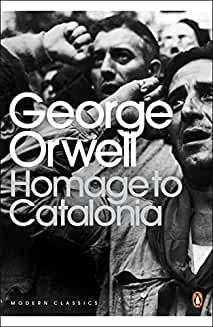 I picked up George Orwell’s Homage to Catalonia from Portland’s famous Powell’s Bookstore several years ago where it dutifully sat on my shelf until February of this year. The book tells of Orwell’s time fighting Spanish Fascists in the 1930s. It provides fascinating detail on what life is like on the front lines during a war with several funny moments and Orwell’s excellent writing. I have to admit, beyond fighting fascists, much of the politics was a bit beyond me. What was interesting was the amount of propaganda in the press and how life simply carries on even in the country where the war is taking place. When he finally leaves Spain, Orwell notes that upon returning to England the milk will be dropped off in the morning like any other day. In his forward, Richard Trilling talks about Populism politics. In what seems like our currently chaotic political times, it is true what people say that so much of this has happened in the past and one only needs to look at history. Unfortunately, history keeps repeating itself but while the darkness is here, this also means some light is around the corner.
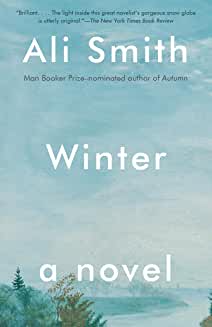 My introduction to Ali Smith was a year and a half ago with Autumn. Late this winter it was time to pick up the next volume in the four book seasonal cycle set – Winter. This was the last book I checked out at the library just before the world went haywire and the libraries shut down. The story follows Art as he travels to visit his Mother over Christmas with his (fake) girlfriend in tow. The book touches on politics, the environment and relationships. Autumn received the acclaim but I think I enjoyed this one even more. Lux, the fake girlfriend, makes an impact on the family and brings them closer together, before she disappears. Sometimes life is like that, meeting people that you will never forget even if they are only around for a few days.